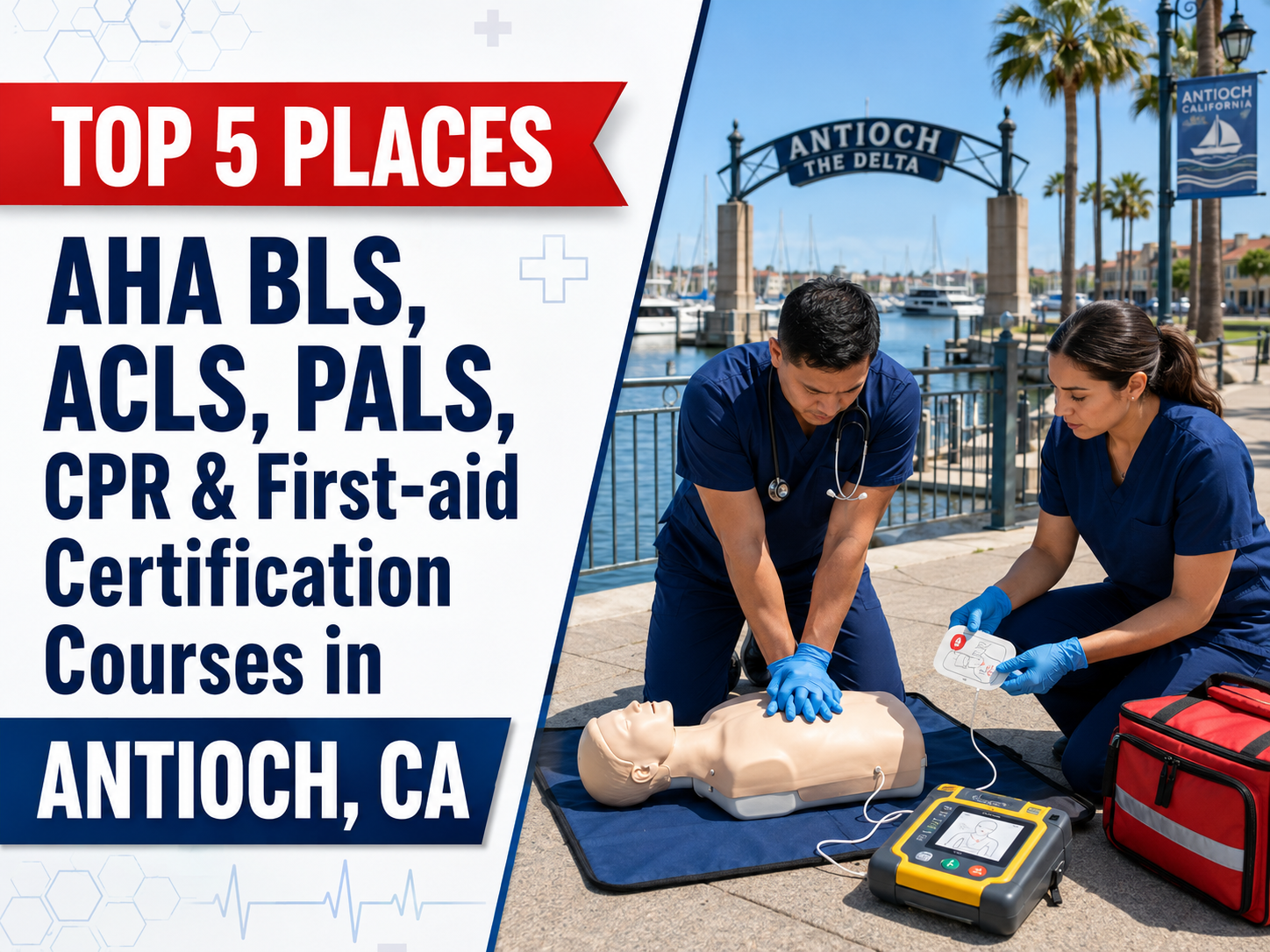
Antioch, California, sits at the eastern edge of Contra Costa County where the San Joaquin Delta meets a fast-growing suburban community. With Kaiser Permanente Antioch Medical Center anchoring the local healthcare network and Sutter Delta Medical Center just minutes away in Pittsburg, the demand for qualified, life-saving professionals has never been higher. Neighborhoods like Lone Tree, Sand Creek, Black Diamond, and Hillcrest are home to thousands of nurses, paramedics, respiratory therapists, and emergency responders who need to maintain their BLS, ACLS, and PALS credentials without disrupting demanding shift schedules.
According to the American Heart Association, nearly 350,000 cardiac arrests occur outside of hospitals in the United States every year. In a region like the East Bay, where Antioch serves as a healthcare hub for surrounding communities including Brentwood, Oakley, and Pittsburg, the pressure on healthcare professionals to stay current with life-support training is real and constant. Public safety agencies, long-term care facilities, and urgent care clinics throughout Contra Costa County require staff to successfully complete the course and receive an AHA Course Completion eCard on a regular renewal cycle.
This guide breaks down two distinct approaches to BLS Course, ACLS Course, and PALS training available in the Antioch area: traditional instructor-led classes and the increasingly popular Self-Guided Learning™ courses delivered through CPR Verification Station™ learning centers. Whether you are a new graduate entering the workforce at John Muir Medical Center in nearby Concord or an experienced nurse renewing your skills at a local Antioch clinic, understanding both options will help you make the right call for your schedule, learning style, and career demands.
Overview of CPR Training Options in Antioch
Before diving into the details, it helps to understand what is actually available for healthcare professionals in the Antioch area. At the core, learners have two primary paths. The first is the traditional instructor-led classroom course, where a trainer facilitates group learning in a scheduled, in-person session. The second is the Self-Guided Learning™ model, which pairs an online curriculum with a hands-on skills evaluation at a CPR Verification Station™ learning center. Both formats fulfill AHA requirements, but the experience, flexibility, and efficiency they offer are quite different.
Traditional Instructor-Led CPR Training in Antioch
Instructor-led BLS, ACLS, and PALS courses have been the standard in healthcare education for decades. In this format, participants gather at a designated classroom location on a set date and time, where a course instructor walks the group through AHA curriculum materials, leads demonstrations, and oversees hands-on skill practice. Learners work through scenarios together, ask questions in real time, and receive immediate feedback from the trainer.
For healthcare professionals working at Kaiser Permanente Antioch Medical Center or the Contra Costa Regional Medical Center in Martinez, instructor-led sessions can feel familiar and structured. Hospital systems and community colleges in the greater Contra Costa County area have historically offered these programs as department-wide training events. Commuters traveling from Brentwood or Oakley to attend sessions in Antioch or Concord are also a common part of this picture.
How Instructor-Led Training Works
A typical instructor-led BLS class in Antioch begins with students arriving at the scheduled time, often early morning or on a weekend. The trainer presents the course content, guides the group through CPR skill demonstrations on manikins, walks through automated external defibrillator protocols, and then evaluates each participant individually before they can successfully complete the course and receive an AHA Course Completion eCard. ACLS and PALS courses follow a similar structure but cover more advanced content, including pharmacology, cardiac rhythm interpretation, and pediatric emergency algorithms, with group case simulations built into the session.
Limitations of Instructor-Led Classes
Despite the familiarity of this format, instructor-led courses come with real-world limitations that are especially difficult for healthcare workers in a busy corridor like Antioch. Fixed scheduling is one of the biggest barriers. A nurse finishing a night shift at Sutter Delta Medical Center in Pittsburg cannot always be expected to show up bright and alert for an 8 a.m. classroom session. A paramedic based out of East Contra Costa Fire Protection District who picks up extra shifts during wildfire season has even fewer windows available.
Travel adds another layer of friction. Antioch is at the end of Highway 4, and anyone driving from the Sand Creek or Black Diamond neighborhoods toward Concord or Walnut Creek for a training session knows firsthand how quickly a commute can turn into an hour each way. Traffic on Lone Tree Way during morning hours is a local reality that can make a supposedly convenient training day feel like anything but. Group pacing is also a constraint — participants who already have strong foundational knowledge are still required to move through the course at the speed of the slowest learner in the room.
The Rise of CPR Verification Stations in Antioch
Over the past several years, the healthcare training industry has seen a meaningful shift toward technology-assisted, flexible learning formats. CPR Verification Station™ learning centers represent one of the most significant developments in this space. Antioch-area healthcare employers, from private medical groups to county health departments, are increasingly accepting — and even actively recommending — this model as a legitimate, high-quality alternative to traditional classroom instruction.
What Is a CPR Verification Station?
A CPR Verification Station™ learning center is a technology-enabled environment where a learner demonstrates their CPR skills on a sensor-equipped manikin that provides real-time, objective feedback. Unlike a classroom setting where a single instructor observes multiple students at once, the station measures compression depth, compression rate, hand placement, and recoil with precision that human observation simply cannot replicate. The result is an evaluation process that is both more accurate and more equitable — performance is measured against a consistent, data-driven standard every single time.
How Self-Guided BLS, ACLS, and PALS Courses Work
The Self-Guided Learning™ model works in two stages. First, the learner completes the online portion of the curriculum, which is powered by True Adaptive™ learning technology through Area9 Lyceum. This platform uses artificial intelligence to continuously assess what the learner already knows and what still needs reinforcement, adjusting the pace and depth of the content in real time. Rather than forcing a respiratory therapist with fifteen years of experience to sit through introductory material they mastered long ago, True Adaptive™ learning focuses their time where it actually matters.
The HeartCode® Complete course is one of the most recognized offerings in this format, covering BLS, ACLS, and PALS content through this adaptive online system. Once the online module is complete, the learner schedules a brief hands-on skills session at a local CPR Verification Station™ learning center, demonstrates proficiency, and successfully completes the course to receive their AHA Course Completion eCard. The entire process is streamlined, efficient, and available on the learner’s own schedule.
Key Advantages of CPR Verification Stations
For healthcare professionals in Antioch and the broader Contra Costa County region, CPR Verification Stations offer several practical advantages that directly address the pain points of traditional training.
Flexibility is arguably the most significant benefit. Online coursework through the HeartCode® Complete program can be completed at midnight, on a lunch break, or between patient appointments. There are no fixed class times, no group waiting periods, and no need to coordinate time off with a supervisor just to sit in a classroom.
Faster completion is another major draw. Because the adaptive platform tailors the curriculum to what each individual learner actually needs, many participants move through the material significantly faster than they would in a paced classroom setting. The skills session at the verification station is focused and efficient, often wrapping up in under an hour.
Objective evaluation removes the subjectivity that can sometimes affect instructor-led assessments. A sensor-equipped manikin does not have a good day or a bad day. It measures performance against consistent, AHA-aligned standards.
Local convenience rounds out the picture. Having access to a CPR Verification Station™ learning center that serves Antioch, Brentwood, Oakley, and the surrounding East Contra Costa County communities means learners do not need to drive all the way to Oakland or San Jose for a quality training experience.
Why Healthcare Professionals in Antioch Prefer Self-Guided Learning
Talk to the nursing staff at Kaiser Permanente Antioch Medical Center or the ER team at Sutter Delta Medical Center in Pittsburg, and a common theme emerges: time is the most precious resource they have. Professionals working rotating shifts in the Hillcrest or Lone Tree neighborhoods of Antioch need a training model that bends around their lives, not one that demands they rearrange their lives around a fixed class schedule.
Self-Guided Learning™ courses deliver exactly that. A physician assistant who finishes a Saturday morning shift can complete their online ACLS course content that afternoon and schedule their verification session for the following week. A pediatric nurse from the Sand Creek area working PALS renewal into a busy fall schedule can access the HeartCode® Complete curriculum from home, with True Adaptive™ technology making the process efficient rather than exhausting.
Instructor-Led vs. CPR Verification Stations: Side-by-Side Comparison
When comparing these two formats side by side, the differences become clear across several dimensions. In terms of flexibility, instructor-led courses lock learners into a specific date and location, while Self-Guided Learning™ programs allow coursework to be completed at any time from virtually anywhere with an internet connection. For time efficiency, a traditional BLS class in Antioch can consume an entire morning or afternoon, whereas adaptive online learning compresses content to only what the individual actually needs. In terms of learning style, classroom training benefits those who genuinely prefer group interaction and direct trainer guidance, while the self-guided model serves independent learners who already have strong foundational knowledge and want to move efficiently. When it comes to evaluation, instructor observation is inherently subjective; CPR Verification Stations provide sensor-based, objective measurement that holds every learner to the same standard. Convenience is perhaps the starkest difference — no scheduling conflicts, no commuting to a classroom in Concord or Pittsburg, and no waiting for the next available group session.
Which Option Is Better for You in Antioch?
The honest answer depends on your individual situation. Instructor-led training may be the right fit if you are brand new to CPR and genuinely want the experience of learning alongside peers, watching live demonstrations, and having direct access to a trainer’s guidance throughout the session. Some learners simply absorb material better in a structured group environment, and there is no shame in that.
On the other hand, if you are a practicing healthcare professional in Antioch with prior training experience, a demanding shift schedule, or a preference for learning at your own pace, Self-Guided Learning™ courses paired with a CPR Verification Station™ represent a clearly superior option. The flexibility, efficiency, and objective evaluation built into this model are purpose-built for the realities of modern healthcare work.
Local Demand for CPR BLS, ACLS, and PALS Training in Antioch
Antioch’s healthcare landscape is expanding. Kaiser Permanente Antioch Medical Center has grown significantly over the past decade, and new medical office developments along Hillcrest Avenue and Lone Tree Way signal continued growth. The East Contra Costa County region, which includes not only Antioch but also Brentwood, Oakley, Discovery Bay, and Pittsburg, is one of the faster-growing healthcare markets in the Bay Area. Sutter Delta Medical Center continues to be a critical acute care facility for the region, while John Muir Medical Center in Concord and Contra Costa Regional Medical Center in Martinez serve overflow and specialty needs for Antioch-area residents.
All of this growth translates directly into ongoing demand for BLS, ACLS, and PALS training. AHA renewal cycles — typically every two years — mean that a substantial portion of Contra Costa County’s healthcare workforce is actively seeking a course or skills session at any given time.
How Safety Training Seminars Supports Modern CPR Training
Safety Training Seminars is committed to making high-quality AHA-aligned training accessible to healthcare professionals throughout the Antioch area. By offering both the Self-Guided Learning™ model through CPR Verification Station™ learning centers and instructor-led options, the program meets learners where they are — whether that means a flexible, tech-enabled experience or a guided classroom session.
The emphasis is always on quality, accessibility, and learner success. Healthcare professionals working in Antioch, Pittsburg, Brentwood, or anywhere in Contra Costa County can access BLS, ACLS, PALS, NRP, and First Aid course completion opportunities through a provider that understands the scheduling demands of real-world clinical work.
The Future of CPR Training in Antioch
The trajectory of healthcare education is moving toward personalized, technology-driven learning — and for good reason. True Adaptive™ learning powered by Area9 Lyceum represents exactly the kind of intelligent, learner-centered approach that the industry is embracing. CPR Verification Station™ technology raises the bar for skills evaluation by removing inconsistency from the equation entirely.
For a city like Antioch, where a growing healthcare system serves an increasingly diverse and expanding population, the flexibility and scalability of modern training formats are not just conveniences — they are necessities.
Start Your BLS, ACLS, or PALS Course in Antioch Today
Whether you are renewing your BLS course completion, tackling ACLS for the first time, or fulfilling your PALS requirements before a new role at a local Antioch facility, the right training path is available and closer than you might think. Self-Guided Learning™ through the HeartCode® Complete program offers flexibility and efficiency that fits the pace of professional healthcare in Contra Costa County. And for those who prefer a more guided experience, instructor-led options remain a solid choice.
The goal is the same either way: successfully complete the course, demonstrate your skills, and receive your AHA Course Completion eCard so you can get back to doing what you do best. Explore your options, choose the format that fits your life, and take the next step in your training today.