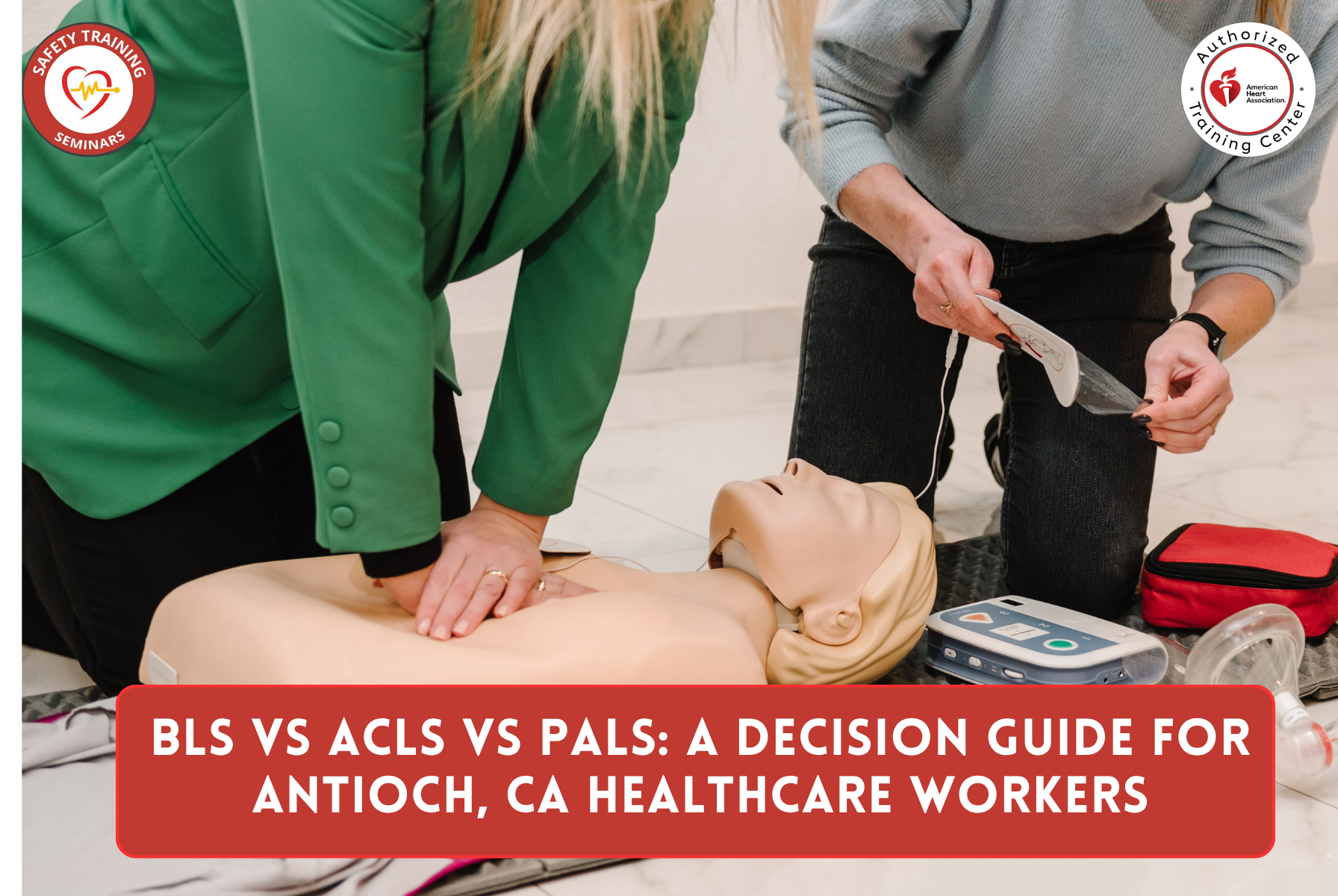
If your employer, nursing program, or licensing board just told you that you need a certification but didn’t specify which one, you’re not alone. Antioch, CA healthcare workers run into this constantly, especially when moving between departments or picking up a new position that lists “current AHA certification” as a requirement without naming the exact course. The short answer: BLS covers basic resuscitation skills for any patient, ACLS builds on that for adult cardiac emergencies, and PALS applies the same advanced thinking to infants and children. Which one applies to you depends almost entirely on your role, your patient population, and what your workplace has put in writing.
Key Takeaway
Most healthcare roles in Antioch require BLS certification first, since it’s the foundation both ACLS and PALS are built on. If your job involves directing care during cardiac arrest or advanced airway management, you’ll likely need ACLS for adult patients or PALS for pediatric patients, sometimes both. When the requirement isn’t clear, checking with your supervisor or HR department before enrolling saves time and money.
What BLS, ACLS, and PALS Actually Teach
Basic Life Support, or BLS, teaches high-quality CPR, AED use, and choking relief for adults, children, and infants. It’s built around the idea that the first few minutes after a cardiac or respiratory emergency matter more than anything that happens later, so the course focuses on chest compressions, rescue breathing, and team-based response rather than diagnosis or medication.
Advanced Cardiovascular Life Support, or ACLS, is designed for clinicians who direct or participate in managing cardiac arrest, stroke, or other cardiopulmonary emergencies in adults. It adds rhythm recognition, airway management beyond a bag mask, and medication protocols on top of the BLS skill set.
Pediatric Advanced Life Support, or PALS, applies that same advanced-care thinking to infants and children, whose airways, dosing needs, and common emergency causes differ from adult patients. A provider who is confident managing an adult cardiac arrest can still be caught off guard by a pediatric respiratory emergency, which is exactly the gap PALS is meant to close.
Matching the Course to Your Role
Job titles alone don’t always tell you which course applies, so it helps to think in terms of what you actually do on shift.
- Direct patient care with basic response duties — teachers, childcare staff, dental assistants, medical office staff, and many CNAs typically need BLS.
- Adult critical care, emergency, or procedural settings — ICU nurses, ER staff, cath lab techs, and physicians who manage adult codes usually need ACLS in addition to BLS.
- Pediatric units, school nursing, or NICU/PICU — nurses and providers who regularly treat infants or children usually need PALS, sometimes alongside ACLS if their unit sees a mixed adult and pediatric population.
- Float staff or per diem clinicians — some Antioch-area hospitals require both ACLS and PALS if scheduling means covering multiple units.
None of these categories are universal rules. Two nurses with the same title at different East Bay facilities can have different certification requirements depending on the unit and the employer’s own policy, so confirming with your manager or HR is worth the five minutes it takes.
Why BLS Comes First
Every ACLS and PALS course assumes you already have solid CPR fundamentals, which is why BLS is treated as a prerequisite rather than an optional add-on. During ACLS or PALS training, instructors move quickly through compressions and basic airway skills to spend more time on rhythm interpretation, medications, and team dynamics during a code. Walking in without current BLS skills makes that pace harder to follow and can affect how much you get out of the advanced course.
If you’re not sure whether your BLS card is current or accepted for the advanced course you’re registering for, most training providers will ask to see it before class, so it’s worth checking the expiration date ahead of time rather than at the door.
Deciding Between ACLS and PALS When Your Job Touches Both
Some Antioch healthcare workers genuinely need both certifications, particularly in emergency departments and EMS roles that treat patients of every age. If your position is split between adult and pediatric care, ask your department whether the employer expects both cards or whether one covers your current assignment with the other planned for later.
What to Expect During Class
BLS classes generally combine short lecture segments with hands-on CPR and AED practice on manikins, along with a skills check to confirm compression rate, depth, and airway technique. ACLS and PALS classes add case-based scenarios where small groups work through simulated emergencies, practicing team roles and the decision points a lead provider makes in real time. Some providers offer blended formats that let you complete the cognitive portion online before an in-person skills session, while others run the full course in the classroom. Either way, expect a hands-on skills evaluation before you receive your completion card.
Training Availability for Antioch and Surrounding East Bay Communities
Antioch sits within reach of several East Bay cities where healthcare workers commonly train, including Pittsburg, Pleasant Hill, Walnut Creek, and Alamo. Many hospital and clinic staff in this part of Contra Costa County don’t work exclusively in one city, so checking course availability across a few nearby locations often makes scheduling easier than waiting on a single site to have an opening. Nursing students juggling clinical rotations, and safety coordinators scheduling entire teams, both benefit from having more than one nearby option when a date is full. Readers commuting from Pittsburg or Pleasant Hill for work often compare class times at both locations before committing to a date.
Where to Complete BLS, ACLS, or PALS Training Near Antioch
Safety Training Seminars operates a training location in Antioch at 3701 Lone Tree Way, Suite 4A, Antioch, CA 94509, offering BLS certification along with ACLS and PALS courses for healthcare professionals working throughout the area. If you’ve confirmed which certification your role requires, the next step is reviewing course dates and format options before registering. Healthcare workers commuting from farther out, including San Ramon or Richmond, sometimes find it easier to check both their local options and the Antioch schedule before deciding where to enroll, since availability varies by course and date. Before registering anywhere, it’s worth double-checking with your employer or licensing board that the course format you’re considering, whether classroom or blended, meets their specific requirement.
Frequently Asked Questions
Do I need BLS before I can take ACLS or PALS? Yes, in nearly all cases. ACLS and PALS courses are built on the assumption that students already have current CPR and basic life support skills, so most training providers require a valid BLS card, or equivalent skills verification, before you can enroll in the advanced course.
Can I complete these certifications through an online-only format? Cognitive content can often be completed online, but AHA-based courses require an in-person hands-on skills check before you receive your completion card. If a program offers a certificate with no in-person skills component, confirm with your employer whether it will actually be accepted.
How do I know if my job requires ACLS, PALS, or both? Check your job description or ask your manager directly, since requirements vary by unit and employer even within similar roles. If your position covers both adult and pediatric patients, your department may require both certifications rather than just one.
Is training available for healthcare workers commuting from Pittsburg or San Ramon into Antioch? Yes. Safety Training Seminars’ Antioch location serves healthcare professionals from throughout the surrounding area, and staff commuting from nearby cities often compare schedules across a few locations, including Pittsburg and San Ramon, before booking a specific class date.
How long does BLS, ACLS, or PALS certification typically remain valid? Validity periods can vary by certifying body and course version, so it’s best to confirm the exact renewal timeline for your specific course when you register, and to check with your employer about any internal renewal deadlines separate from the certification’s own expiration date.
Making Your Next Decision
Choosing between BLS, ACLS, and PALS comes down to your patient population and what your employer, school, or licensing board actually requires, not which course sounds more advanced. Start by confirming that requirement in writing if you haven’t already, then work backward: BLS first if you don’t currently hold it, followed by ACLS, PALS, or both depending on the patients you treat. For Antioch healthcare workers ready to move forward, Safety Training Seminars’ Antioch training location offers a starting point for reviewing current course dates and formats for BLS, ACLS, and PALS, alongside nearby options in Pittsburg, Pleasant Hill, San Ramon, and Richmond for anyone whose schedule makes a different city more convenient.